
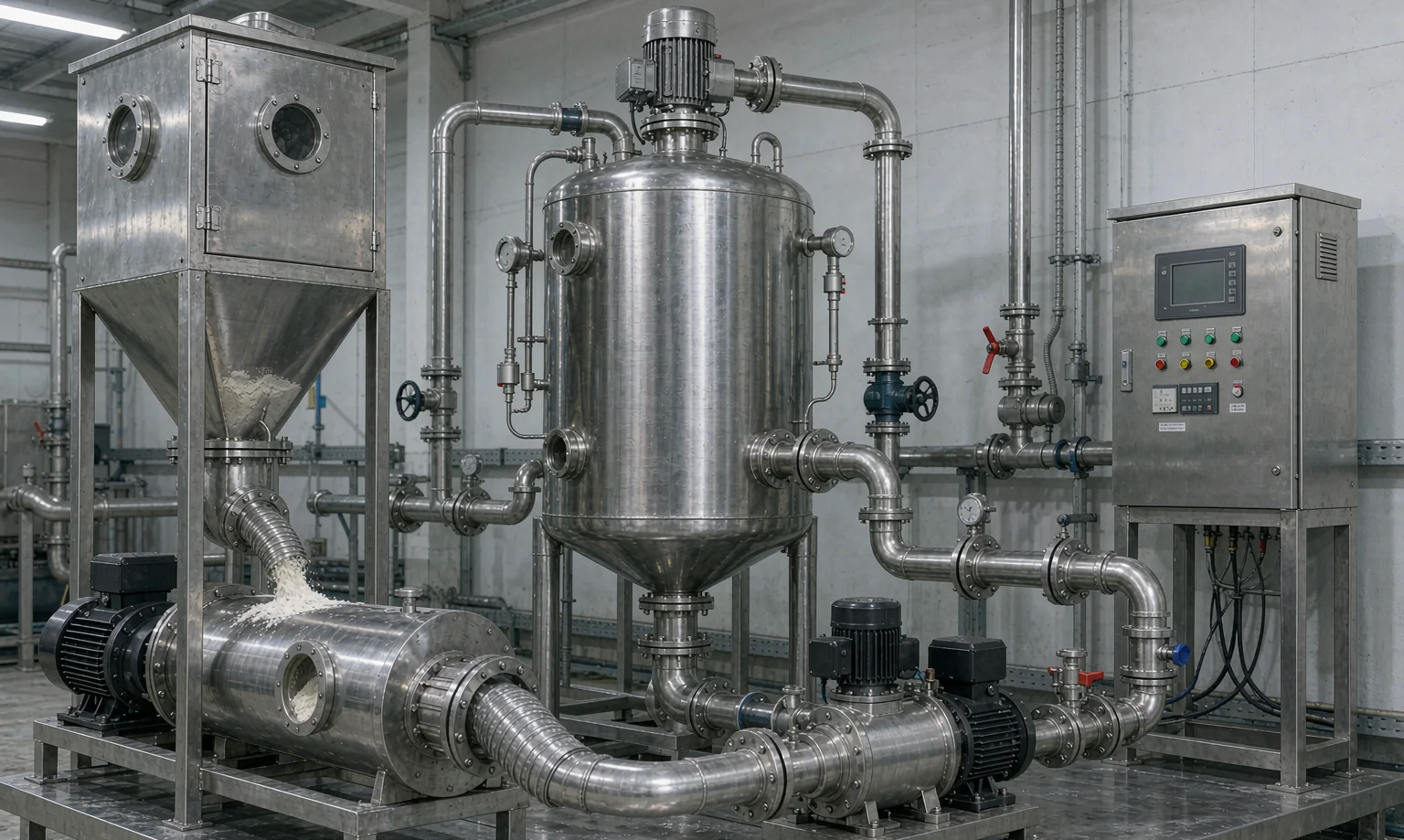
Wet and disperse the powder first
Powder must be wetted and dispersed before it hydrates. Adding it too fast forms fish-eyes that waste polymer and block filters.
Use the feeder and wetting path that will be used in service. Confirm a uniform dispersion before aging.
Allow enough aging time
Hydration time depends on molecular weight and water temperature. Cutting it short leaves part of the polymer inactive.
Measure the time needed to reach stable solution quality with site water and protect it in the operating procedure.
Control water and mixing
Dilution water quality, temperature and mixing energy affect dissolution and chain condition. High shear after hydration can damage long chains.
Record water source, temperature and mixer settings, and avoid high-shear transfer of hydrated solution.
Dilute to the final feed strength
Prepare at a concentration the system can hydrate, then dilute to the feed strength used in the trial.
Keep preparation and dilution consistent between the bench test and plant operation.
Check solution before dosing
Look for fish-eyes, lumps, excess bubbles and unexpected viscosity. Do not dose a poor batch to compensate for preparation.
Prepare a fresh reference solution when performance changes and fix preparation before changing dose.
Keep an operator record
Record product code, lot, preparation time, water conditions and the solution check for each batch.
A preparation record turns a performance complaint into a traceable investigation.
Wet every particle before hydration starts
Dry polymer forms a gel skin when it meets water too quickly, leaving a fish-eye with a dry core. Even wetting of each grain is what prevents that, not longer mixing later.
Sprinkle into a moving water surface and avoid dumping a solid mass into a stagnant zone.
Respect the make-down concentration
Powder is usually prepared at a low stock concentration because the solution becomes very viscous as chains hydrate. Higher concentration is not faster if the mixer cannot turn the batch.
Prepare at the concentration the mixer can handle and dilute to feed strength only after hydration is complete.
Age, then dilute, then dose
Hydration needs time; dilution before full hydration wastes that development and can carry gel particles into the feed. The sequence wet, age, dilute, dose is what protects solution quality.
Measure the time to full viscosity development at the site water temperature and build that hold into the operating procedure.
Diagnose fish-eyes at the wetting step
Fish-eyes form when powder is wetted too quickly or dispersed into too small a vortex, leaving a dry core inside a gel skin.
Correct the wetting water ratio and dispersion energy before increasing mixing time or dose.
Keep the make-down tank clean
Residue from an old batch, scale or biological growth can change hydration and contaminate the next solution.
Set a cleaning interval and inspect the tank and lines as part of the preparation record.
Plan for cold water
Low temperature slows hydration and raises solution viscosity, so the same grade can behave differently across seasons.
Confirm the aging time at the coldest expected water temperature and adjust the hold before winter.
Know when hydration is complete
A fully aged solution is uniform, free of fish-eyes and close to its expected viscosity. Raising dose cannot recover polymer that never hydrated.
Set a simple visual or viscosity check at the end of aging and reject a batch that has not reached it.
Limit the life of prepared solution
Prepared polymer solution can lose performance during long storage as it degrades, supports microbial growth or absorbs contaminants.
Match the batch size to realistic use, control tank turnover and discard solution held beyond the qualified window.
Carry the product evidence into purchasing
Use the demonstrated feed, preparation and separation window to bound a commercial proposal. The appropriate next purchase checks are Powder Polyacrylamide Feeder: Purchase and Capacity Checks; Emulsion Polyacrylamide Inversion Unit: Purchase Checks.
Retain candidate and production codes with the trial record. Resolve untested feed conditions, preparation changes and documentary requirements before accepting a routine supply substitution.