
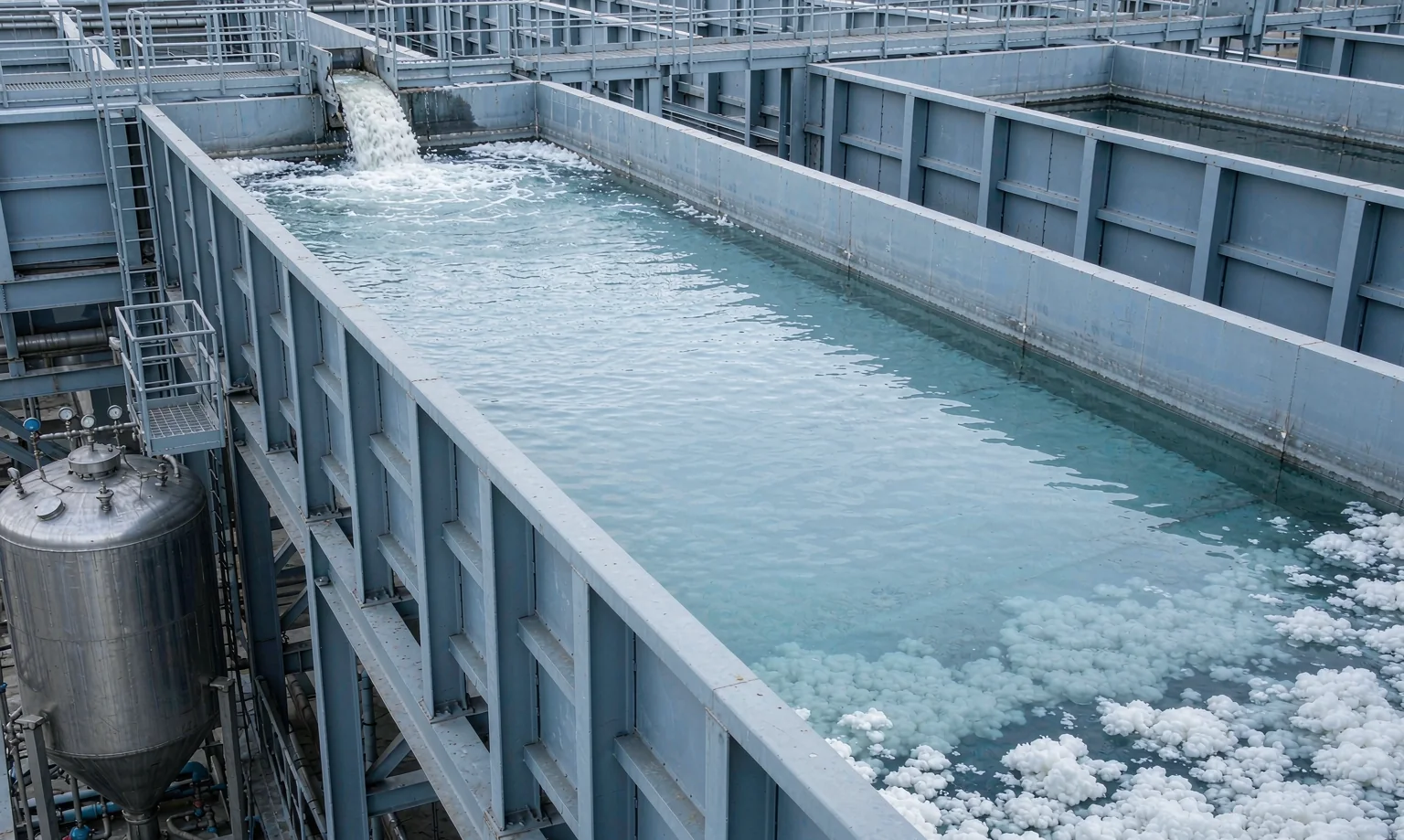
A family of water-soluble polymers
Polyacrylamide polymer refers to water-soluble polymers made from acrylamide units and supplied with different charge types and molecular weights. Cationic, anionic and nonionic families cover a wide range of products.
The generic name is not a specification. A code, charge basis, molecular-weight class and active content identify what is actually supplied.
How it conditions particles
The polymer interacts with suspended particles through charge neutralization and bridging between chains. Particles aggregate into larger floc that separates more easily.
The useful result is measured as clarity, settling or drainage on the real feed, not by the appearance of floc in isolation.
Where it is used
Polyacrylamide polymer is used wherever solids must be separated from water, including municipal and industrial water, process streams and solid-liquid separation duties.
Each duty has its own feed and equipment. A grade approved for one condition must be rechecked before it is used on another.
Powder and emulsion forms
The product is supplied mainly as dry powder or as an emulsion dispersion. The two forms differ in active content, preparation and storage requirements.
Compare forms on active polymer mass and on how well the site can prepare and meter each one.
What to record in a trial
A trial record should carry the product code, feed chemistry, preparation method, active dose and measured outcomes.
Keep the evidence with the sample identity so a supplier or a later operator can reproduce the work.
Buy the demonstrated grade
Purchase by the approved identity and the feed window where performance was shown, not by a generic product name.
Treat a change of family, charge or molecular weight as a revalidation rather than an equivalent substitute.
Name the polymer by four fields
A usable product identity carries the ionic family, the charge basis and level, a molecular-weight class and the active content. A marketing name or a single grade number describes none of these.
Write all four fields on the sample request so a supplier cannot answer with a different product under the same label.
Separate the polymer from the coagulant
A polyacrylamide is a flocculant that bridges or neutralizes particles; a coagulant such as PAC works by charge compression ahead of it. The two are often used in sequence, not as substitutes.
State which chemical is dosed first in the trial record, because the same polymer behaves differently ahead of and after a coagulant.
Expect a dose window, not a dose number
The useful dose depends on solids, surface charge and mixing. It is reported as active polymer per dry solids or per cubic metre of feed, not as a fixed volume for every site.
Record both the applied dose and the measured result so the number can be translated to another feed with a known solids load.
Place the product among related chemicals
Polyacrylamide polymer is a flocculant or coagulant aid, not a disinfectant, pH adjuster or scale inhibitor. It works on particle separation rather than on dissolved contaminants.
Keep that boundary in the specification so the product is not proposed for a duty that needs different chemistry.
Read a product code before a marketing name
Trade names change between markets, while a code tied to ionic family, charge basis, molecular-weight class and active content stays traceable.
Ask the supplier to map any trade name to that code in the quotation and on the bag label.
Track the unit basis through the record
Dose can be written as active grams per dry tonne of solids, as prepared-solution flow or as neat product feed. Only the first is comparable across feeds and forms.
State the unit beside every number and convert back to active mass before comparing two offers.
Carry the product evidence into purchasing
Use the demonstrated feed, preparation and separation window to bound a commercial proposal. The appropriate next purchase checks are Polyacrylamide Polymer Price: Compare on an Active-Polymer Basis; Polyacrylamide Polymer Trial Order: Quantity Planning.
Retain candidate and production codes with the trial record. Resolve untested feed conditions, preparation changes and documentary requirements before accepting a routine supply substitution.